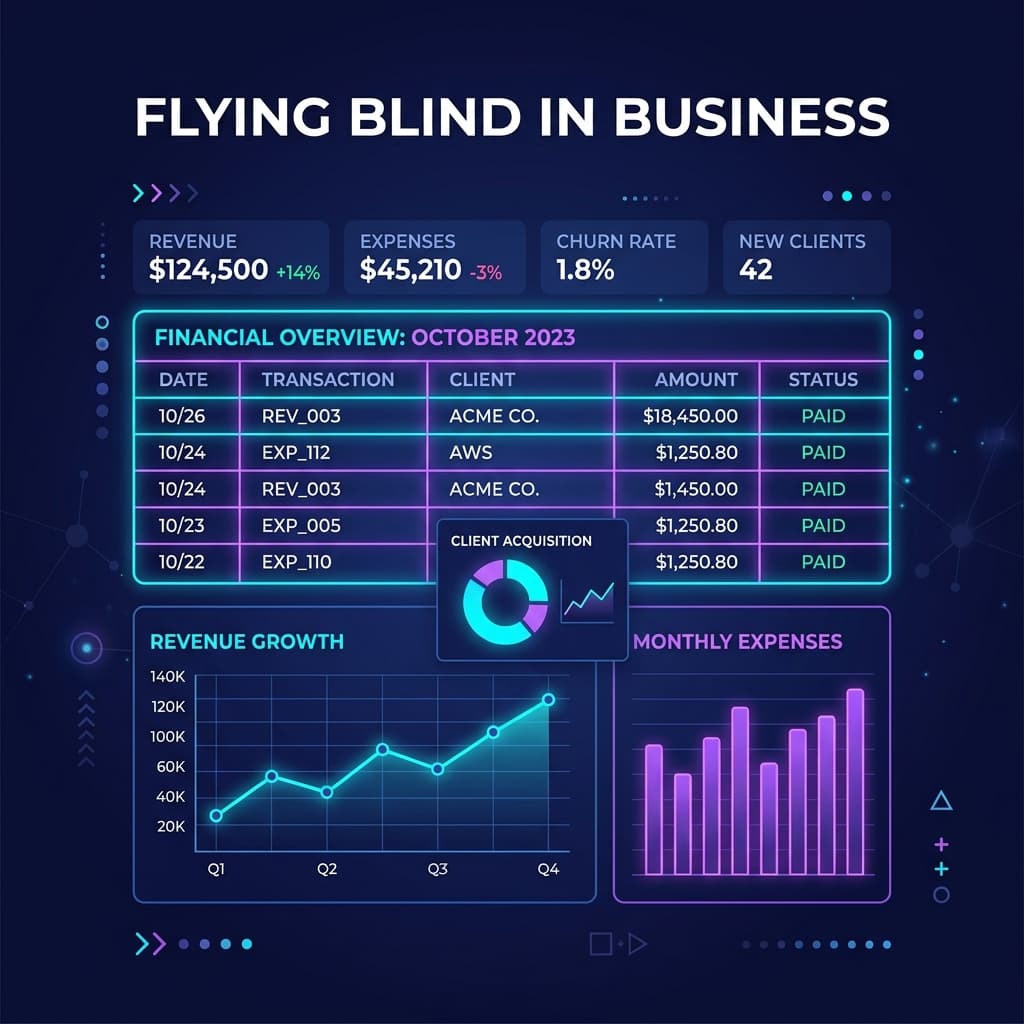
Flying Blind: Why You Can’t Make Strategic Business Decisions Without Organized Books
Treating your financial documentation as a mere compliance obligation is an expensive strategic mistake.
When your books are messy, disorganized, or constantly backlogged, you are running your company with your eyes closed. You are flying blind.
Niseni Angammana
Co-Founder, BizDocs
When you talk to early-stage founders about what drives their business forward, they usually point to things like product innovation, aggressive marketing campaigns, or closing major client accounts. They view growth through the lens of offensive action.
Rarely does an entrepreneur sit down and enthusiastically boast about their ledger, their indexing system, or their receipt tracking process.
Bookkeeping and administrative documentation are traditionally viewed as a defensive chore, a tedious tax compliance task that you begrudgingly hand over to an accountant at the end of the financial year just to keep the authorities happy.
But treating your financial documentation as a mere compliance obligation is an expensive strategic mistake.
When your books are messy, disorganized, or constantly backlogged, you aren’t just risking a stressful tax season. You are running your company with your eyes closed. You are flying blind.
In business, clean bookkeeping isn't just about accounting; it is your ultimate strategic dashboard. Without accurate, indexed tracking, you cannot calculate your true unit economics, you cannot predict cash flow crunches, and you cannot make high-level scaling decisions with confidence. Here is why pristine documentation is the true engine behind strategic growth, and how organizing your books transforms how you lead.
1. The Margin Illusion: Revenue vs. True Profitability
The most dangerous metric a founder can obsess over in isolation is top-line revenue. Seeing a large influx of cash into your business bank account creates a false sense of security. It makes you feel like your strategies are working.
However, revenue can easily mask a deeply unprofitable business model.
Without meticulous bookkeeping that links every single line-item expense to its corresponding project, client, or product line, you are operating on guesswork. You might see that your digital agency brought in $50,000 last month, but without structured indexing, you won’t notice that a specific client required 80% of your team's billable hours, custom asset purchases, and software overhead, effectively rendering that massive account a net-negative drain on your capital.
Organized books allow you to calculate your true gross margin. It reveals exactly which of your services or products are highly profitable assets and which ones are quietly eating away at your bottom line. True strategy is about doubling down on what works and cutting what doesn't, but you need clean data to tell the difference.
2. The Danger of Scaling a Broken Engine
When an unindexed business starts gaining momentum, the founder's natural instinct is to scale up immediately. They want to hire more staff, invest heavily in paid acquisition, or expand their operations.
But scaling a business with unorganized financial tracking is like pressing the nitrous oxide button in a car that has a severe engine leak. It doesn't fix the underlying issue; it just gets you to the crash much faster.
Before making the strategic decision to incur fresh fixed costs (like employee salaries or software subscriptions), you must be able to run a clear historical cash-flow analysis. Clean books allow you to run accurate calculations on core growth metrics:
• Customer Acquisition Cost (CAC): The exact total spend required to land a single client.
• Lifetime Value (LTV): The actual net profit generated over the lifespan of that customer relationship.
• Burn Rate & Runway: Exactly how many months your business can survive if revenue unexpectedly drops to zero.
If your records are buried in unorganized folders, scattered across text files, or stuck inside emails, you cannot calculate these numbers accurately. You risk hiring a new team member based on a "good month," only to realize two quarters later that your baseline recurring cash flow cannot sustain their salary.
3. Mitigating the Risk of "Silent Crushes" (The Cash Flow Reality)
A business can be highly profitable on paper and still go bankrupt next week. This happens because of timing mismatches your revenue is locked up in unpaid client invoices, while your expenses (rent, utilities, vendor bills) demand immediate settlement.
Organized books and disciplined document indexing provide you with forward-looking visibility. When your past performance data is cleanly categorized, you can accurately map out your upcoming financial cycles. You can spot a seasonal cash dip three months before it happens, giving you the strategic window needed to adjust your terms, pause non-essential expenditures, or renegotiate payment timelines with vendors.
When your files are in disarray, you lose this predictive radar. You don't realize you are entering a cash crunch until the exact day a transaction bounces. At that stage, you are no longer making strategic decisions; you are operating in panic mode.
4. Moving from Emotional Leadership to Data-Driven Execution
The most exhausting part of running an early-stage startup is the cognitive load. When your administrative documents are unindexed and your books are chaotic, every single operational decision requires an immense amount of emotional energy. You spend hours second-guessing whether you can afford a premium upgrade, whether you should pivot your pricing structure, or whether it’s time to raise prices on your current client base.
Clean financial documentation eliminates the noise. It replaces gut feelings and emotional anxiety with absolute mathematical certainty.
When your metrics are pristine, a strategic choice becomes glaringly obvious. You don't have to "feel" if it's the right time to expand; your dashboard clearly illustrates your operating leverage, your margins, and your safety reserves.
Final Thoughts: Treat Data as Your Competitive Advantage
If you want to build a resilient, scalable enterprise, you have to stop viewing accounting and documentation as an annoying administrative burden.
Pristine records are an operational asset. They give you the speed to move quickly, the security to survive economic shifts, and the clarity to make aggressive, high-stakes strategic moves without guessing.
Clear the fog from your dashboard. Clean up your ledgers, organize your document pipelines, and stop flying blind.
What is the biggest operational decision you are trying to make right now?
Do your current books give you the exact data you need to make it safely? Let's talk.
Visit BizDocs.lk